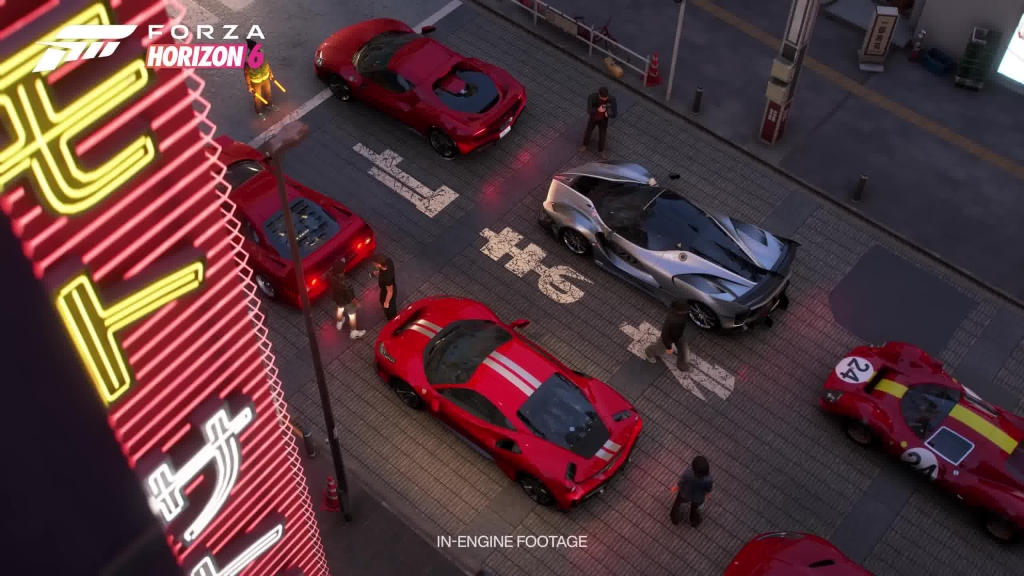

Forza Horizon 6 immediately signals a shift in tone from its predecessors: it’s louder, faster, and more structurally focused on time attack culture and extreme build experimentation. The gameplay loop shown here is not just about racing—it’s about engineering philosophy, tuning ideology, and the psychological war between grip, power, and driver confidence.
At its core, FH6 introduces a car culture sandbox where meta builds (especially Skyline variants and time attack machines) dominate early experimentation. Players are no longer just collecting cars—they’re actively dismantling them, rebuilding them, and iterating lap-by-lap under pressure.
1. The Core Gameplay Loop: Build vs Build Time Attack Rivalry
The featured gameplay revolves around a structured challenge:
- One player builds “meta time attack cars”
- The other builds “counter-meta street builds”
- Both compete on repeated time trial circuits
- Incremental tuning adjustments decide victory
This creates a loop where engineering decisions matter as much as driving skill.
Competitive Structure Breakdown
| Phase | Activity | Objective |
| Phase 1 | Select base cars (S15, Skyline variants) | Establish baseline performance |
| Phase 2 | Full tuning + upgrades | Maximize grip, power, aero |
| Phase 3 | Time trial runs | Establish benchmark laps |
| Phase 4 | Iterative tuning | Optimize lap consistency |
| Phase 5 | Final showdown | Compare best times |
The key takeaway: FH6 rewards iteration density. The more frequently you adjust tuning and re-test, the more competitive you become.
2. The Time Attack Meta: Why “Infinite Grip“ Changes Everything
One of the defining observations in FH6 is the exaggerated grip behavior in time attack builds:
“Forza with infinite grip… it almost doesn’t make sense.”
Time attack cars are described as:
- High-downforce builds
- Extremely stable mid-corner
- Difficult to “feel” at the limit
- Forgiving at high speed but punishing on exits
Typical Time Attack Build Profile
| Attribute | Characteristic |
| Downforce | Very high (massive wings) |
| Tire width | Maxed or near-maxed |
| Drivetrain | AWD dominant |
| Stability | Extremely high |
| Skill ceiling | Surprisingly low entry, high mastery ceiling |
This leads to an interesting paradox: the easier a car is to drive, the harder it becomes to optimize.
3. The Nissan Skyline Arms Race
A major theme is the dominance of Skyline platforms, particularly:
- R32 Skyline
- R33 Skyline
- S15 Silvia (new generation emphasis)
The game leans heavily into Japanese performance culture, especially time attack aesthetics.
Skyline Build Comparison Table
| Car | Strength | Weakness | Meta Role |
| R32 Skyline | Balanced AWD grip | Heavy feel | All-round time attack base |
| R33 Skyline | Stability under load | Less agile | Consistency builder |
| S15 Silvia | Lightweight agility | Lower base torque | Tune-flex platform |
A key insight from the gameplay is that platform choice matters less than tuning philosophy. The same Skyline can behave completely differently depending on:
- Tire width
- Aero configuration
- Engine swap choice (including R35 swaps)
- Weight reduction strategy
4. Engine Swaps and Power Inflation Strategy
A recurring decision point is aggressive engine swapping, including:
- V10 swaps
- R35 engine conversions
- Twin-turbo configurations
This creates a dual-meta system:
Power-first builds
- 900–1200+ HP
- High straight-line dominance
- Difficult corner exit control
Balance-first builds
- Moderate horsepower
- Improved rotation and braking stability
- Faster lap consistency
Power vs Control Tradeoff Table
| Strategy | HP Range | Cornering | Stability | Lap Consistency |
| Power Build | 1000–1200+ | Medium | Low | Inconsistent |
| Balanced Build | 700–900 | High | High | Strong |
The gameplay shows a clear realization: more horsepower does not guarantee faster laps in FH6.
5. Tuning Philosophy: Where Most Time Is Actually Lost
A significant portion of performance gains comes not from upgrades, but from micro-adjustments:
- Tire width reduction to improve rotation
- Gear ratio optimization for acceleration zones
- Aero balancing between top speed and corner stability
- Drivetrain swaps affecting traction behavior
A key moment in the session is the realization that:
“I think I’ve topped what I can do with it.”
This is a classic FH tuning breakpoint—when incremental changes stop producing measurable lap improvements.
6. Time Trial Performance Progression
The time trial segment highlights how rapidly lap times evolve through tuning adaptation.
Lap Time Evolution (Example Session)
| Attempt | Time | Notes |
| Run 1 | ~43s | Learning phase, instability |
| Run 2 | ~32s | Major improvement, better line control |
| Run 3 | ~50+ s (errors) | Overdriving and resets |
| Run 4 | ~38s class range | Stabilized competitive pace |
Key insight: driver adaptation matters as much as build optimization.
Small mistakes—missed braking points, oversteer on exits, checkpoint errors—create disproportionate time loss.
7. Aerodynamics: The Invisible Meta Factor
One of the most important revelations is the dominance of aero performance:
- Large wings improve corner entry stability
- Excess aero can reduce straight-line efficiency
- Non-adjustable aero limits tuning flexibility
The “Forza Aero wing vs custom widebody wings” decision becomes a critical optimization branch.
Aero Decision Impact
| Setup | Corner Speed | Straight Speed | Stability |
| High Downforce | High | Low | Very High |
| Balanced Aero | Medium | Medium | Medium |
| Low Aero | Low | High | Unstable |
The conclusion from gameplay: aero is effectively a “hidden difficulty slider.“
8. FH6 Economy and Progression Pressure
A subtle but important constraint is resource limitation:
- Limited credits early game
- Costly upgrades and swaps
- Skill point dependency for performance unlocks
This introduces strategic tension between:
- Immediate performance upgrades
- Long-term build investment
- Experimental tuning risk
This is where systems like Forza Horizon 6 Credits indirectly shape progression pacing, since credit flow determines how aggressively players can iterate builds.
9. The Emerging Meta: What FH6 Really Rewards
From the gameplay behavior, a clear meta structure emerges:
FH6 Optimal Strategy Stack
- Start with lightweight, high-balance chassis (S15, Skyline variants)
- Apply moderate-to-high power swap (not maximum)
- Maximize grip before maximizing horsepower
- Tune for consistency, not peak speed
- Iterate laps, not just builds
The biggest misconception debunked:
“More power equals faster lap times.”
In FH6, this is only true up to a threshold—beyond that, control degradation overtakes performance gains.
10. Conclusion: FH6 Is a Tuning Simulator Disguised as an Arcade Racer
Forza Horizon 6 pushes the franchise further into a hybrid identity:
- Arcade accessibility remains intact
- But tuning depth now dominates competitive outcomes
- Time attack builds define the skill ceiling
- Skylines and Japanese platforms anchor the meta
The result is a game where winning is less about driving fast once—and more about building the right machine for repeatable speed.And in that environment, progression systems and optimization layers (including decisions around FH6 Credits) quietly influence how quickly players can reach the competitive ceiling of the game.